Share this article
When rugby pride becomes entitlement
Pride in the All Blacks is earned. The assumption that rugby belongs to New Zealand is not — and the complaints about the Springbok scrum show exactly where one becomes the other.
Key Takeaways
- ✓ Before isolation the Springboks led the All Blacks 20 Tests to 15, and led five series to three.
- ✓ Almost all of New Zealand's present advantage in the rivalry was built between 1992 and 2017, while South Africa rebuilt from 11 years out of the game.
- ✓ Since 2018 South Africa leads nine to seven with one draw, and holds four world titles to New Zealand's three despite missing the first two tournaments.
- ✓ An allegation from an opposing coach is not proof. Apply the laws rigorously and equally, and when a side dominates legally, call it what it is.
New Zealand has every right to be proud of the All Blacks. They have been one of rugby's greatest teams, and during the Richie McCaw era they were unquestionably the dominant force in world rugby.
Nevertheless, pride can harden into entitlement.
Among certain sections of New Zealand rugby there appears to be an ingrained assumption that when the All Blacks dominate it is because of their brilliance, and that when South Africa dominates there must be something wrong — with our tactics, our scrummaging, or even the laws of the game themselves.
Two different questions after a defeat
South Africans hardly need outsiders to criticise the Springboks. When we lose, the inquest often begins before the final whistle. We dissect the selections, the substitutions, the discipline, the tactics and the coaching, usually with more enthusiasm than mercy.
When the All Blacks lose, certain sections of New Zealand rugby seem more inclined to turn their fire outwards. The referee was influenced. The scrum was illegal. The tactics offended rugby's values. The laws themselves need attention.
We tend to ask: what did our team do wrong?
Those critics too often ask: what were the winners allowed to get away with?
That difference goes to the heart of entitlement.
The record before isolation
The historical record challenges any claim to natural rugby supremacy.
Before South Africa's isolation, the Springboks led the All Blacks by 20 Tests to 15, with two draws. South Africa had also won five series to New Zealand's three.
The balance changed dramatically after our return. Between 1992 and 2017, New Zealand won 42 Tests against South Africa's 15, with one draw. That period created virtually the whole of New Zealand's present advantage in the rivalry.
What coming back actually cost
South Africa was not returning to the rugby landscape it had left. We had spent 11 years in isolation. We were then required to rebuild our international structures, adapt almost immediately to professionalism, and transform a historically exclusive sport into one representing the entire country. All at once.
At times, blunt quota and selection-target policies added pressure to an already difficult transition. Nobody can reasonably attribute every defeat to transformation. It would be equally dishonest to pretend that restructuring an entire national sport carried no competitive cost.
Transformation as strength
That is not an argument that black players weakened Springbok rugby. The present team emphatically disproves any such suggestion.
Transformation ultimately broadened our talent pool and produced a side that genuinely belongs to the whole country. Rassie Erasmus's achievement was to harness that complete talent base and turn diversity into strength — an underrated and worthy achievement, and one that clearly contributed to his honorary doctorate.
The results are telling. Since Rassie took charge in 2018, South Africa leads New Zealand nine victories to seven, with one draw, as of 29 August 2026. We have won consecutive World Cups in 2019 and 2023. South Africa now holds four world titles to New Zealand's three, despite being excluded from the first two tournaments. We entered this series as the world's number one side.
The scrum, and how a narrative gets made
This is the context in which Dave Rennie's complaints about the Springbok scrum should be viewed.
Rennie is entitled to raise legitimate technical questions. Every coach seeks clarification and tries to influence how matches are refereed. Repeatedly presenting an allegation as though it were established fact is something else.
New Zealand struggled against the Springbok scrum and then accused South Africa of illegally walking around it rather than scrummaging straight. Rennie publicly indicated that New Zealand would take its concerns to World Rugby. Rassie responded that this group of Springbok forwards has scrummaged together, in substantially the same manner, under the world's leading referees for years without facing this accusation. He also asked why New Zealand's early scrums repeatedly collapsed on their own feed.
The law is clear. Both packs must begin square, stable and stationary, and must push straight and parallel to the ground. If South Africa infringes, penalise us. An allegation from an opposing coach is not proof, and tactical lobbying should not become the lens through which the next referee views every scrum.
That is how narratives are manufactured, and it is easy. Repeat the accusation often enough, circulate it through the media, and ensure the next official walks out actively looking for it — as we saw in the second Test.
From law into theology
The same pattern is now appearing over Rassie's late team changes, and here the criticism has wandered out of law and into theology.
New Zealand Herald rugby writer Gregor Paul concedes that Rassie operates within rugby's laws but outside its spirit, before producing an epic crime sheet and casting him as a rugby supervillain.
What crime, exactly?
This independently administered series permitted late team changes. Rassie rearranged players already named in his match-day squad. If administrators dislike that latitude, write a rule and close it. Until then, clever use of the regulations is gamesmanship, not an ethical collapse.
Rugby's values exist to protect integrity and respect. They are not an emergency clause to be invoked whenever one coach out-thinks another. The complaint is not that Rassie broke a rule. It is that he ignored a rule these critics wish had existed.
Who gets the benefit of the doubt
The moral concern sounds particularly rich coming from a camp led by Dave Rennie. In 2021, while coaching Australia, he described refereeing decisions against Wales as horrendous and said they played a major part in the result. World Rugby issued him with a formal written warning after he apologised. Rugby's sacred code apparently survived that, yet now trembles because Rassie rearranged a legal match-day squad.
The contrast in how these matters are treated is uncomfortable.
In 2021, Rassie produced a detailed, hour-long analysis identifying numerous refereeing inconsistencies during the British and Irish Lions series. World Rugby found that the manner in which he criticised and challenged the match officials constituted misconduct. He was suspended from all rugby activities for two months, and from match-day activities until September 2022. Those were severe sanctions, formally imposed for his conduct and his public criticism. It was also clear that this was not a blanket finding that every concern he identified was imaginary.
Yet an opposing coach can now publicly portray South Africa's primary strength as potentially illegal, announce that he is taking the matter to World Rugby, and place that narrative directly in front of future referees.
The contest is the point
There is a broader concern. World Rugby increasingly appears determined to prioritise speed and uninterrupted movement over rugby's traditional contests.
In 2024 it removed the option of choosing a scrum from a free kick, explicitly to keep the ball flowing. Shot clocks and other measures have since reduced the time available for scrums and lineouts. World Rugby says these changes promote entertainment and player welfare, and there is no public evidence that they were designed specifically to disadvantage South Africa. Their cumulative effect nevertheless reduces the value of the areas in which the Springboks traditionally excel.
Worth noting: the Springboks attract full houses wherever they play.
Scrums, lineouts, mauls and physical confrontation are not defects in rugby union. They are fundamental to what distinguishes it from rugby league. A weaker scrum is not entitled to protection from a stronger one. A smaller pack is not entitled to have the maul diminished because it cannot stop it. The proper response to legal superiority is to improve, not to lobby for that superiority to be regulated out of the game.
And now ball-in-play time is offered as the measure of spectator quality. Rugby league has plenty of ball in play. Ask any rugby union supporter what they make of it.
Apply the laws, equally
South Africa is not asking to be placed above scrutiny. Apply the laws rigorously and equally. Penalise us when we infringe. When we dominate legally, acknowledge it for what it is: superior execution.
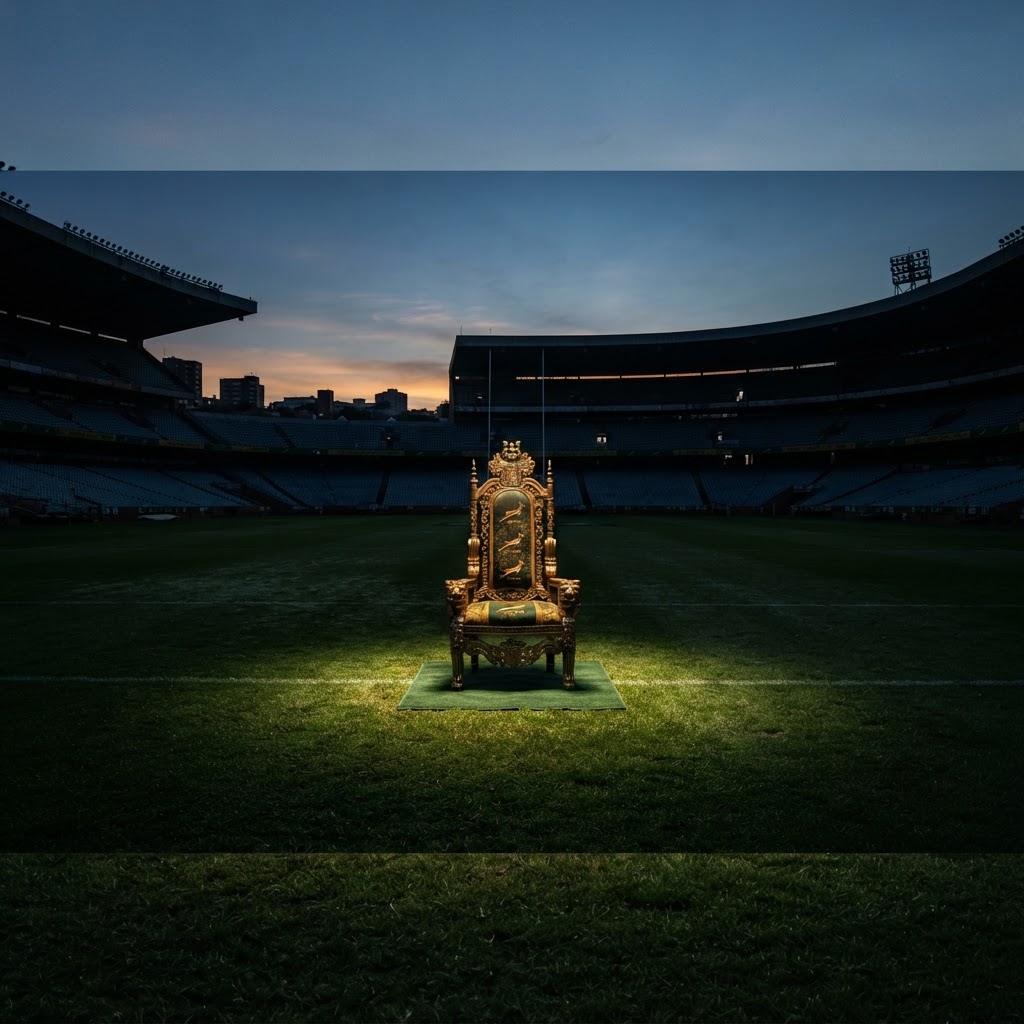
The All Blacks once occupied rugby's throne with distinction. They never owned it.
Perhaps New Zealand's present discomfort is not that South Africa has broken rugby. It is that South Africa has broken the comforting belief that rugby belongs to New Zealand.
False entitlement is unpalatable at the best of times. It is more distasteful still when dressed up as the moral high ground.
Frequently Asked Questions
What was the Springbok record against the All Blacks before isolation?
The Springboks led 20 Tests to 15 with two draws, and led five series to three. Almost all of New Zealand's present advantage in the rivalry was built between 1992 and 2017.
What is the record since Rassie Erasmus took over in 2018?
South Africa leads nine victories to seven with one draw, as of 29 August 2026, and holds four world titles to New Zealand's three despite being excluded from the first two World Cups.
Did Rassie Erasmus break a rule with his late team changes?
No. The series permitted late changes and the players involved were already named in the match-day squad. The objection is to a rule the critics wish had existed, not to one that does.
Free email · no account needed
More like this, straight to your inbox
Stories, guides and what's on for South Africans in the UK — plus every Boks, Proteas and Bafana fixture with the UK channel. Free.
Email only, unsubscribe any time. Privacy notice
Analytics
We'd like to use Google Analytics to count visits and see which pages get read. It stores an ID on your device. Say no and the site works exactly the same — nothing here affects signing in, the match-day poll or the newsletter, which don't need your permission because they only do what you asked for.
You can change this any time on our cookies and storage page.
Have your say
No account needed — say your bit and post. Disagreement welcome; abuse gets removed.
Nobody has said anything yet. Go on.